Cancer Vaccines, no longer science fiction
By Helena Strigård
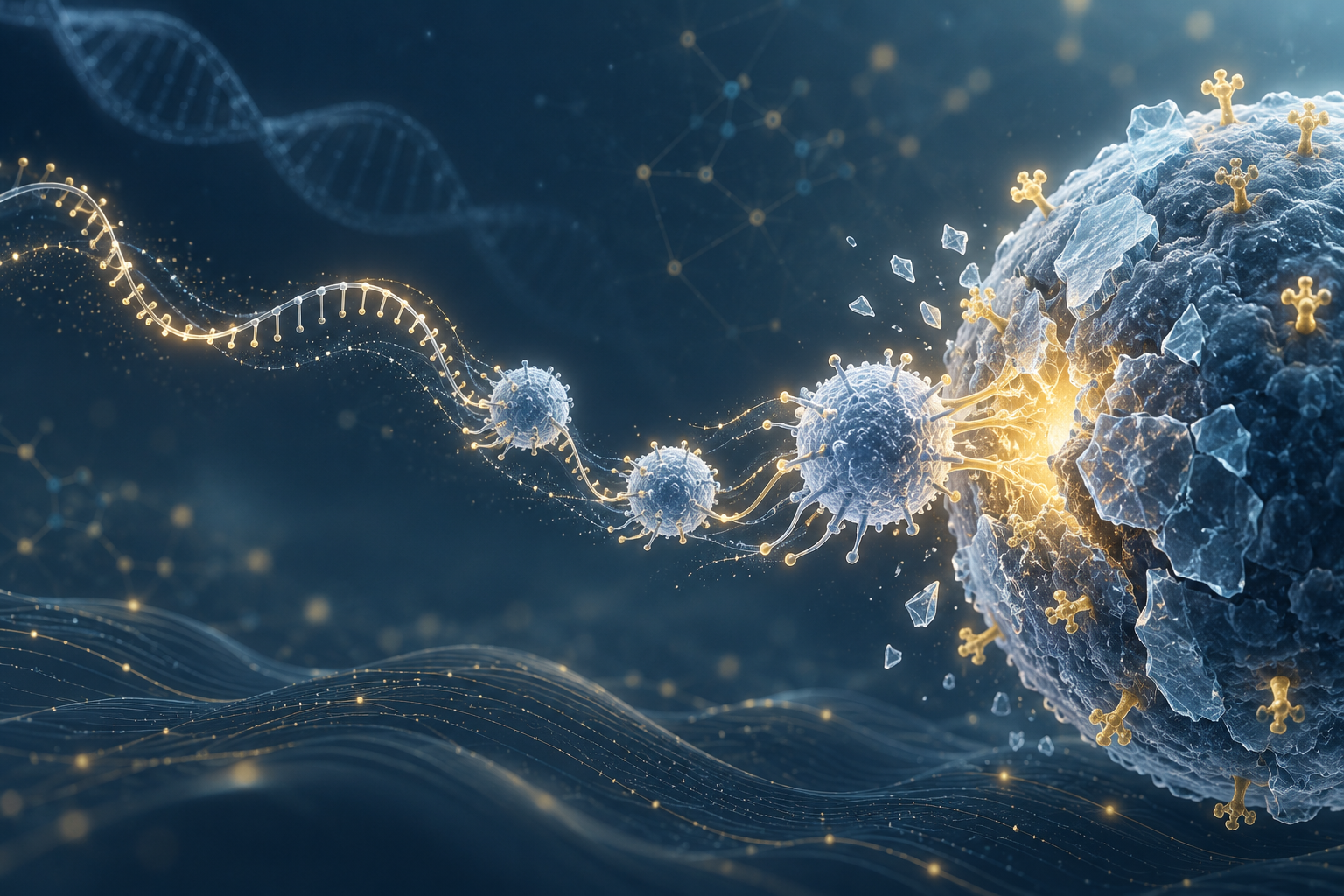
After two decades as the idea that never quite worked, the personalised cancer vaccine has cut melanoma recurrence by 49 per cent in Phase 3. Researchers, a founder and an investor unpack what changed, what it will cost and which tumours come next. Read the full article.
For two decades the cancer vaccine occupied an awkward place in oncology: biologically plausible, clinically disappointing, almost challenging to finance. That changed on 19 August, when Moderna and Merck reported Phase 3 results in some 1,100 patients whose malignant melanoma had been surgically removed. Their individualised mRNA vaccine, given with the checkpoint inhibitor Keytruda, cut the risk of recurrence by 49 per cent against Keytruda alone, and the risk of spread to distant organs by 59 per cent. Moderna closed up 177 per cent that day.
“This is a completely new technology for treating cancer,” says Matti Sällberg, professor of biomedical analysis at Karolinska Institutet, “and the first really good example that a personalised cancer vaccine can be made within a reasonable time.”
What changed
Eniko Toke has been making the argument behind that result since before the field was ready to hear it. She co-founded Treos Therapeutics in 2016 and built its PASCal platform on the proposition that whether a cancer vaccine works comes down to matching its targets to the patient’s own HLA genetics and in 2021 she and her colleagues tested the idea against a meta-analysis of 94 vaccine trials.
The earlier trials, in her reading, were never failures of biology.
“Clinically it was a failure, because even most of the large studies did not produce the expected statistically significant endpoints,” she says. “However, in each study there was a signal. In each study, a few patients benefited. What we had to do was learn why some patients benefit and others do not.”
Two answers came out of that work, and the Moderna trial uses both. The first is knowing what to aim at which of a tumour’s mutations the immune system will actually recognise. That is easiest where there are many to choose from, which is why melanoma came first: it is a cancer that mutates a great deal, and, as Sällberg puts it, relatively easier to treat than many others.
The second answer is less comfortable, because it means a vaccine that provokes a textbook immune response can still lose.
“We somehow didn’t take into consideration that the tumour also reacts to this immune response and tries to suppress and counteract it,” Toke says. “Moderna was very smart to combine the vaccine with a checkpoint inhibitor, which proactively addresses that.”
Which is where the week’s other result comes in. Within days, BioNTech terminated a trial using comparable technology in microsatellite-stable (MSS) colorectal cancer, given alone without checkpoint blockade in a tumour that carries few mutations to begin with. Toke has not seen the immunological data and says any interpretation is speculative, but she is clear on one point.
“The problem is not that there is no target in MSS colorectal cancer,” she says. “There are different targets.”
Her point is that MSS and MSI-H colorectal cancers have different antigenic landscapes. MSS tumours generally harbour fewer private mutation-derived neoantigens and may rely more on recurrent shared tumour-associated antigens, creating an opportunity for off-the-shelf vaccination. It is also the indication Treos Therapeutics’ lead programme is built for, which gives her a stake in the answer.
What could this cost?
The Moderna vaccine is a manufacturing problem as much as a biological one. Tissue from the patient’s tumour is sequenced, the mutations unique to that tumour are identified and written into the product, and the whole process takes around six weeks. Then there is the bill.
“This will not be free,” Sällberg says. “It could well run from 100,000 kronor to a million per patient.”
Toke counts from screening to first dose rather than from biopsy, which gets her to two or three months, and she is blunt about what that asks of a hospital.
“Right now, healthcare systems are not prepared to do that, for sure,” she says. “The FDA will not only need to approve a drug. It will need to approve a service together with the drug.”
Sällberg thinks that problem has been solved once already. During the pandemic an updated COVID vaccine did not have to repeat the full approval process, because the regulator had already cleared the method. “The regulator approves the procedure for producing the vaccine,” he says, “and the individual vaccines are then approved automatically.”
Whether the wait matters at all depends on the patient. Following surgery and being tumour-free (the setting the melanoma trial studied) two months is tolerable. In refractory disease it is no, patients with advanced colorectal cancer routinely progress inside that window. An off-the-shelf product, as Toke puts it, “has a lot of practicality, especially in the late stage refractory setting where patients need a treatment right away.”
That is the bet Treos has made: one vaccine optimised for genetically broad populations, paired with a diagnostic that reads a patient’s HLA genotype from saliva or blood and predicts who will respond. “We developed not only a drug,” she says, “but also a diagnostic.”
“Moderna develops the drug for the patient,” Toke says. “We select the patient for our drug.”
For Ruti Alon, who invests in the sector and sits on the boards of Treos and Alpha Tau Medical, the Phase 3 changes the arithmetic for everyone raising money in a field investors had written off and the conversation in the clinic. “This moves the needle from ‘experimental hope’ to ‘imminent reality’,” she says. “It vastly accelerates clinical trial recruitment.”
The hard to treat tumours
Carl-Henrik Heldin has been asked when cancer will be cured for most of his forty years in this field . His answer has not changed.
“I don’t believe there is any magic bullet,” says the professor of molecular cell biology at Uppsala University. “We have to accept that this will happen gradually. There are certain cancers where the prognosis is still very poor and we do not have much to offer patients. I am thinking above all of brain tumours and pancreatic cancer.”
Of those two, pancreatic cancer is the one getting worse: more common, globally, with no clear lifestyle explanation, and on the projections Heldin cites it will be the third, possibly second, most common cause of cancer death within twenty years. It is also the hardest case for everything above. A cold tumour, poor in mutations, shielded from the immune system, and fast enough that few patients can wait two months for a drug to be built for them.
The field is going there anyway. “Several Phase 1 and 2 trials of vaccines against pancreatic cancer are under way,” Sällberg says. “Some have cautiously promising data, and I am hopeful we will see progress within the next ten years. It is of course hard for someone who is ill today to wait for a drug that will arrive tomorrow.”
Toke expects more approvals over the next five years, off-the-shelf vaccines following the individualised ones, with BioNTech’s pancreatic candidate among the likely next. Alon’s hope is that local tumour destruction combined with systemic immunotherapy turns a rapidly fatal disease into a manageable one.
Asked what the melanoma result means for patients, Malin Sund, professor of surgery at Umeå and Helsinki university hospitals and chair of its research committee the Swedish Cancer Society sent the following statement:
“The development of cancer vaccines represents a highly promising field of research with the potential to transform oncological treatment. Although current data is encouraging, it is critical to note that these therapies remain in clinical development. Continued research and larger-scale trials are essential to determine patient benefit and optimise clinical application.”
The reservation is not decorative. The detailed results are not published; they are due at a cancer conference this autumn. The trial’s duration has not been disclosed, so nobody outside the two companies yet knows how long the protection lasts.
Sällberg does not think the wait will be long, though patients will need following for years. “I think it could start being used within one to a couple of years,” he says. “This is not science fiction at all.”
For Heldin, gradual has never meant stalled. What he wants from the market is a shorter road from promising laboratory work to the clinic, before the patent term and the investors’ patience are both used up.
“We will increase the chances that treatment works,” he says, “and survival figures will get better and better. Even for these difficult tumour types.”
The melanoma trial finally answered whether a cancer vaccine can work. The harder question is whether one can be ready on the day a patient with a cold, fast-moving tumour needs it, without a biopsy, sequencing run or six-week wait. That is the space Treos Therapeutics has chosen: shared-antigen vaccines, and a diagnostic that picks its patients in advance. "Moderna has shown the immune system can be taught to fight," Toke says. "Now we have to bring that to the patients who have no other viable treatment options."